
How to Tell Your Customers About Your Loyalty Programme (Most Businesses Get This Wrong)
Building a loyalty programme is the easy part. Getting customers to notice it, understand it, and actually join is where most independent businesses fall short.

Spend an afternoon building a loyalty programme and you will quickly discover how much thought goes into the mechanics: what to offer, how many stamps, when to trigger a reward. Spend the following week watching sign-up numbers and you will discover a second problem that nobody warned you about. The programme is ready. The customers have no idea it exists.
Communicating a loyalty programme is a different skill from designing one, and it is the skill that most guidance glosses over. This post is the one that covers it properly.
Why getting the communication right matters more than the offer
The reward structure of a loyalty programme is one factor in whether customers join. The communication around it is a bigger one. A well-designed programme with poor communication will grow slowly. A straightforward programme with clear, consistent communication can build a meaningful member base within months.
What’s at stake
Customers who join a loyalty programme early, when momentum is building, tend to become your most engaged members. Customers who hear about it for the first time six months after launch join into a programme that already feels established, which changes how they perceive the value. Getting communication right from the start is not just about volume. It is about building the right kind of member base from the beginning.
Welcome emails generate four times as many opens and ten times more clicks than other types of email. For a loyalty programme, this makes the welcome message sent at sign-up the single highest-value communication you will ever send to a member. Most businesses either send nothing or send a generic confirmation that wastes the moment entirely.
Source: Invesp / email marketing benchmark research — invespcro.com/blog/welcome-emails/ (data from multiple studies, 2022-2024)
The five moments that build a loyalty member base
Every new member passes through a predictable sequence of potential touchpoints, from the first time they hear about the programme to the moment they decide whether to keep engaging with it. Most businesses leave most of these moments unattended.
The conversation at the till
This is the most important single moment and also the most commonly mishandled. A half-hearted “do you have a loyalty card?” at a busy till is not a recruitment tool. It is the verbal equivalent of a small print disclaimer. The version that works is specific and brief: “We have a loyalty scheme — after ten visits, your eleventh coffee is free. I can sign you up on your phone right now if you would like.” That is a benefit, a mechanic, and a call to action in two sentences. It should be part of every new staff member’s first week.
In-store signage and receipts
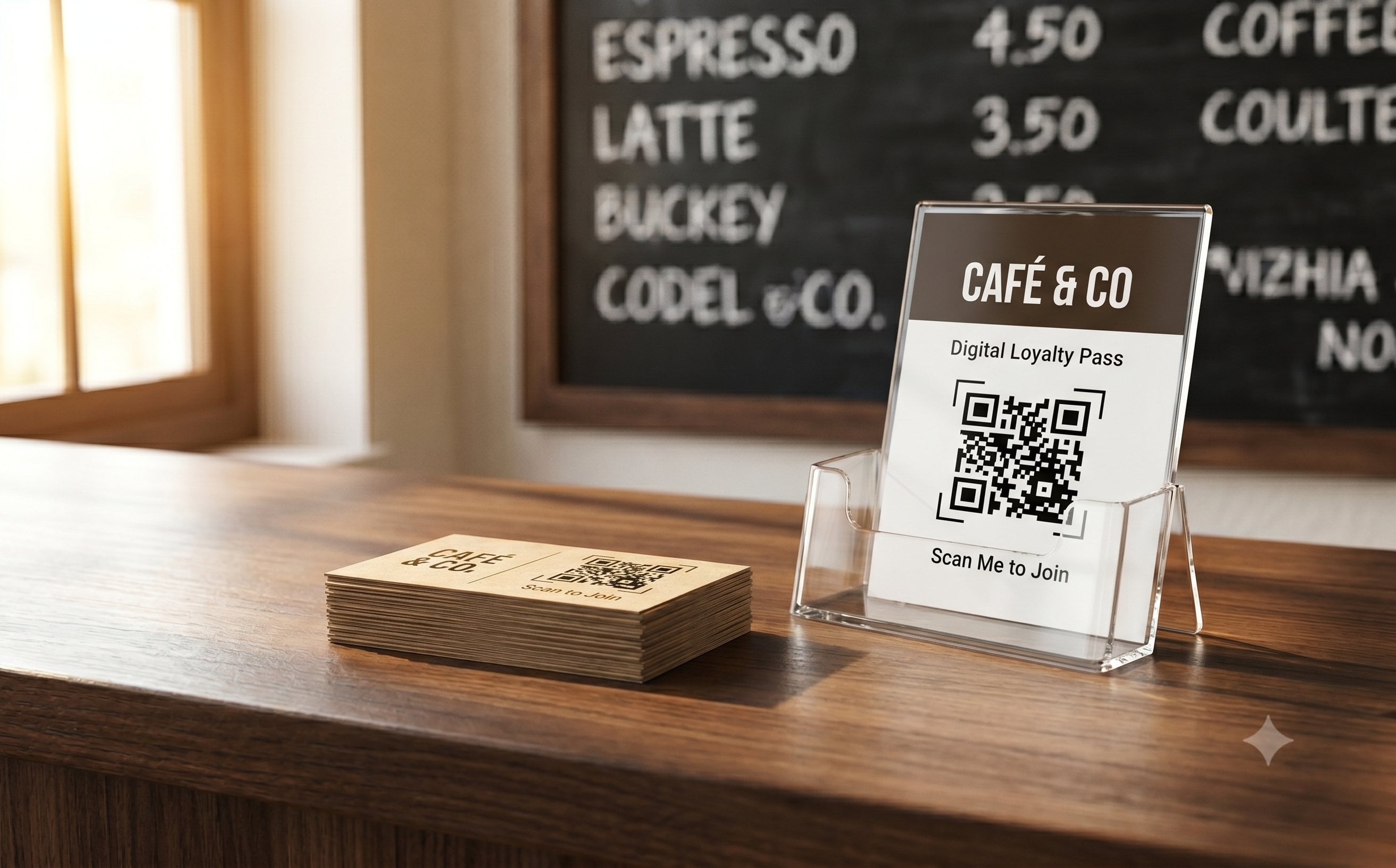
Signage works when it is positioned where customers already pause: at the till point, on tables if you have them, and near the exit. The copy should state one benefit, not explain the whole system. Receipts are underused in most businesses and can carry a simple one-line prompt: “Join our loyalty programme: ask at the counter or visit loyalty.dog.” It adds nothing to the cost of printing.
The welcome email
The welcome email is the highest-value message you will ever send a member, and the evidence for this is clear (see the stat above). Send it within 24 hours of sign-up. Keep it to four or five sentences. Name the benefit they have just unlocked, tell them how it works in plain terms, and end with a single action, which is to make their next visit. For guidance on setting up automated email sequences that require no ongoing effort, see our post on email automation for small businesses.
Social media
Loyalty posts on social work when they treat members as an in-group, not a marketing audience. “Our loyalty members got first access to the new menu this morning” is content. “Sign up to our loyalty programme today!” is not. The first creates desirability. The second creates noise. Post about the programme two or three times a month, always from the perspective of what members experienced rather than what the programme offers.
What the evidence shows
The businesses that grow their loyalty member base most quickly share one characteristic: they treat programme communication as an ongoing operational habit rather than a one-off launch task. Sign-up is mentioned at the till every day. The welcome email goes out automatically. Social posts about the programme appear regularly rather than in occasional bursts.
Getting found by new customers is a separate but related challenge, and local search plays a larger role than many independent businesses realise. Customers searching for “coffee shop near me” or “salon in [town]” are often loyalty-programme candidates who have not yet heard of you. Our post on using local SEO to get found by new customers covers how to increase that visibility without a large budget.
What works, and for whom
Verbal communication at the till has the highest single-interaction conversion rate but requires consistent staff training to maintain. Email performs best for welcome and re-engagement. Social performs best for desirability and word-of-mouth. None of the five moments is optional: each serves a different part of the sign-up and retention journey, and gaps in any one of them show up as slower growth.
Making the call
If you are launching a programme for the first time…
Set up the welcome email before you open sign-ups. Brief staff on the two-sentence till conversation before the first customer is enrolled. Put signage up at the counter on day one. These three things take a morning and they account for the majority of sign-up volume in the first month.
If your programme is live but sign-up is slow…
Audit the five moments in this post and identify which ones are missing. In most cases, the problem is either no welcome email (members join and hear nothing) or inconsistent till communication (staff have stopped mentioning it). Both are fixable within a week without changing the programme itself.
If you run multiple sites…
Consistency across sites matters more than you might expect. A customer who joins at your town-centre location and then visits your out-of-town site should receive the same experience and the same communication. If staff training is inconsistent across locations, programme growth will be inconsistent too.
A loyalty programme does not grow because it exists. It grows because someone tells customers about it, consistently, at the right moments.
Frequently asked questions
How do I get staff to mention the loyalty programme consistently?
Make it part of your till script rather than an optional add-on. Write out the two-sentence version of the pitch, practise it with new staff in their first week, and include it in any till process checklist you already use. Regular brief reminders at team handovers also help, particularly with seasonal or part-time staff who may not have the habit yet.
What should a loyalty programme welcome email actually say?
It should confirm what the customer has joined, state one clear benefit in plain language, tell them how to earn their first reward, and end with a reason to visit again soon. Four to five sentences is the right length. Avoid jargon, avoid points explanations, and avoid trying to cover everything the programme offers. The welcome email is an invitation, not a manual.
Is social media worth the effort for promoting a loyalty programme?
Yes, but only if the posts treat the programme as a benefit rather than an advertisement. Content that shows what members experienced — early access, a surprise reward, a personal thank-you — builds desirability. Posts that simply tell people to sign up perform poorly. Two or three posts per month, framed from the member perspective, is enough to keep the programme visible without dominating your feed.
Make sign-up part of every customer visit
LoyaltyDog makes it straightforward for customers to join at the till, on their phone, or through a link — and sends your welcome message automatically, so nothing falls through the gaps.
See how it works →